















A reflective note on the new term of the Gujarat High Court Advocates’ Association
— Advocate Salony Katariya
Ahmedabad | December 20, 2025| The recently concluded elections of the Gujarat High Court Advocates’ Association have ushered in a new leadership.
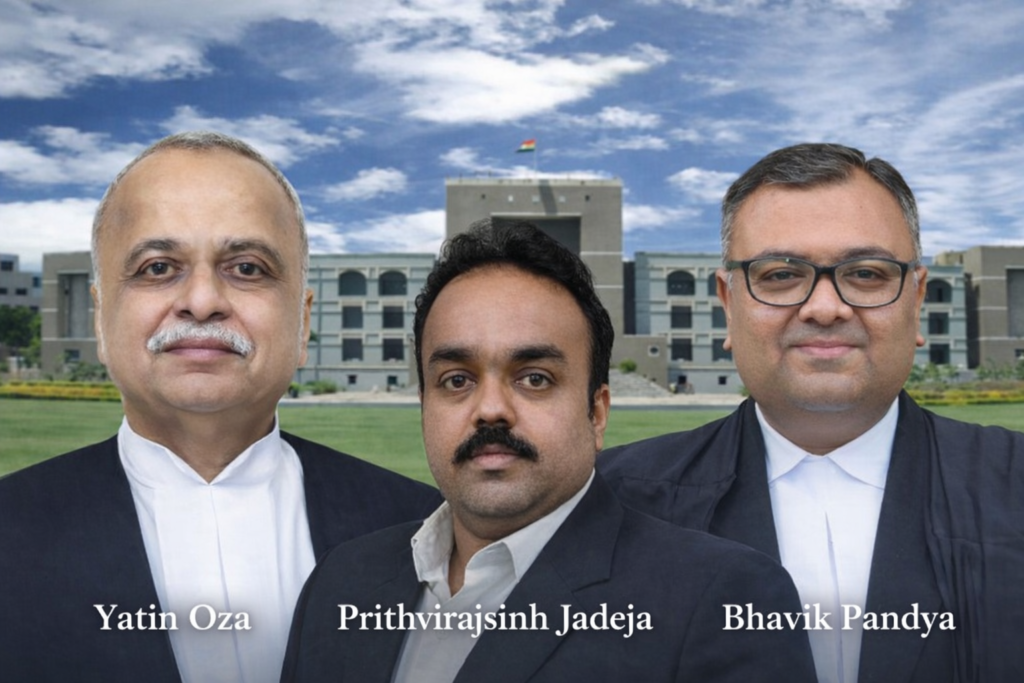
Senior Advocate Yatin Oza has been elected President for a record eighteenth time, securing 969 votes out of the 2,185 polled.
Prithvirajsinh Jadeja has been elected Vice-President, while Bhavik Pandya will serve as Secretary.
These elections have taken place at a moment when electoral processes are simultaneously underway across 278 Bar Associations in the State.
Seen against this wider institutional backdrop, the leadership transition at the Gujarat High Court Advocates’ Association is more than an internal organisational development. It is widely viewed as a signal of the Bar’s priorities, its work culture, and the direction it may take in the years ahead.
Bar elections are never merely exercises in reallocating offices. They also reflect how a professional collective imagines its future, and which sections of the Bar see their aspirations acknowledged within that vision.
It is therefore natural that with the beginning of a new term, expectations rise alongside experience and continuity.
This article is neither a celebration of electoral victory nor a forum for critique. Its purpose is to draw attention to a section of the Bar that participates actively in every election, yet often remains peripheral to institutional priority-setting and policy discourse. This section is young advocates.
Young Advocates: The Backbone of the Bar, Yet the Most Precarious
In the everyday functioning of the High Court, young advocates are among the first to arrive and the last to leave. From filing counters to the final rows of courtrooms, their labour forms the unseen scaffolding of the judicial system.
Despite this centrality, their professional journey continues to be marked by uncertainty.
Technical objections at the filing stage, repeated listing difficulties, the growing complexity of digital procedures, and unequal access to chamber-based learning together create a professional reality in which perseverance is tested as relentlessly as competence.
This is not the consequence of any single individual’s failure, nor of one institution’s neglect. It is a structural challenge that has taken shape gradually over years.
Responsibility Beyond the Mandate
A new term represents more than a continuation of leadership. It calls for a renewal of institutional vision.
The challenges faced by young advocates are not demands for special concessions. They are directly connected to the efficiency, credibility, and future resilience of the justice delivery system itself.
A Bar in which young advocates feel secure, adequately trained, and institutionally respected is one that remains strong over time.
In this spirit, the present piece is offered not as a formal declaration, but as an invitation to dialogue.
An Open Appeal to the Newly Elected President
Respected President,
Your long-standing association with the Bar and your experience in its leadership are widely acknowledged. It is on this foundation of trust that young advocates naturally hope the forthcoming term will not merely stand for continuity, but will also mark meaningful progress toward structural reform.
This appeal does not arise from grievance or discontent. It stems from a belief that the Bar’s leadership possesses the institutional capacity to ensure that filing and listing procedures become clearer, simpler, and more predictable for young advocates.
That structured training and assistance are developed for the effective use of digital systems.
That mentorship is institutionalised as a Bar policy rather than remaining dependent on individual goodwill.
And that functional ease within the High Court premises is recognised not merely as a convenience, but as a professional entitlement.
Young advocates do not seek preferential treatment. Their expectation is modest and reasonable: that their labour, time, and learning be accommodated within a fair, transparent, and capable institutional framework.
Strengthening the Bar Through Dialogue
This article does not conclude with definitive prescriptions. Its purpose is not to conclude, but to initiate conversation.
The Gujarat High Court Advocates’ Association has a tradition of periodic introspection, and that moment presents itself once again.
This context acquires added significance because the Association’s election forms part of a broader electoral process spanning 278 Bar Associations across the State. The priorities articulated today have the potential to influence not only one Bar, but the wider ecosystem of the legal profession.
If the present term advances with the practical challenges of young advocates at its centre, it will not merely be remembered as a successful tenure. It will stand as a lasting institutional legacy, one that strengthens the Bar for generations to come.