















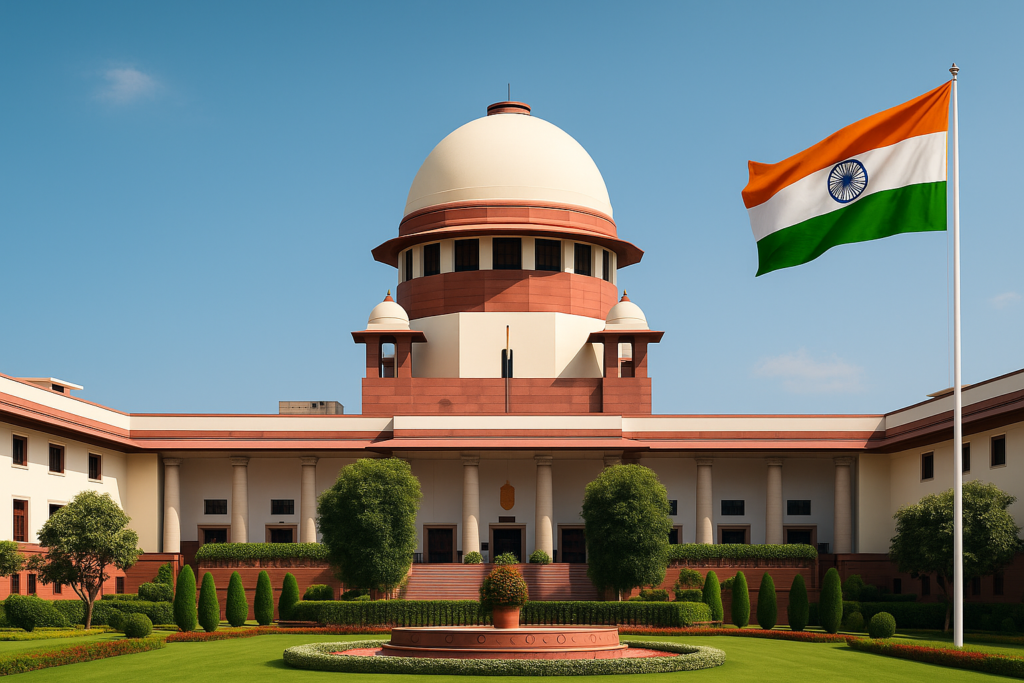

Ahmedabad, December 3, 2025 । For many years, the “final judgment” of the Supreme Court of India was regarded not merely as a legal conclusion but as the foundational source of judicial stability and public trust. It was this very foundation from which the legitimacy and credibility of the judicial system appeared to derive strength.
In recent months, however, particularly during the tenure of Chief Justice Bhushan Gavai, emerging patterns suggest that the Court’s traditional sense of finality looks less secure. A detailed study published by the Supreme Court Observer (SCO) identifies five notable trends that indicate a shifting understanding of what finality may represent today.
The study notes that certain matters previously considered conclusively disposed of were placed again for hearing, even though the established avenues of review or curative jurisdiction would ordinarily govern any return to such cases. The question is not whether the Supreme Court possesses the authority to revisit its decisions; that authority is unquestioned. The concern arises when such reconsideration occurs outside traditional procedural routes and when the reasons for doing so are not fully articulated in the public domain.
In such circumstances, issues relating to procedural transparency and institutional predictability naturally surface. Several constitutional scholars have also begun considering whether an informal pattern of “reopening” cases may be emerging within administrative processes.
The study further notes situations in which directions or observations of a coordinate bench cannot revisit or dilute another coordinate bench’s holdings; only a larger bench may do so. The long-standing judicial convention has been clear: decisions of a bench may be reconsidered only by a larger bench, not one of equal composition.
Such developments suggest that bench composition and subsequent administrative changes may have a direct bearing on how the outcome of a case evolves. For litigants and lawyers accustomed to the belief that “the Supreme Court’s word is final,” these circumstances raise new questions regarding established assumptions of judicial discipline and certainty.
The report also records instances where oral observations and directions acquired such prominence in later proceedings that they appeared to cloud the clarity of written orders already on record. Judicial doctrine has consistently held that courts speak through their written orders.
If oral remarks begin guiding the course of proceedings to the extent that parties become uncertain about what the binding position truly is, the foundational principle of judicial certainty is weakened.
The study additionally highlights scenarios in which, in matters of constitutional significance, the hearing process or composition of the bench underwent changes without detailed administrative reasoning being made publicly available. While the Chief Justice’s administrative authority over the roster is well recognised, procedural or structural adjustments in cases of high constitutional importance naturally invite discussions concerning transparency and institutional accountability when their reasons remain undisclosed.
Taken together, these trends suggest that the traditional conception of a “final judgment” may no longer possess the same unchanging character it once did. Finality today appears shaped not only by legal reasoning and written pronouncements but also by administrative discretion, evolving procedural norms, and internal institutional dynamics.
This does not amount to criticism of any individual judge or bench. Rather, it reflects an evolving judicial environment in which constitutional courts must navigate complex political conditions, shifting social expectations, and emerging technological realities.
The implications of this evolution extend well beyond academic debate. Supreme Court decisions determine the course of public policy, delineate constitutional boundaries, define individual rights, and directly influence the daily lives of millions.
When lawyers, governments, researchers, and citizens rely upon a judgment as “final” for shaping expectations, strategies, and legal positions, and when that finality becomes susceptible to re-examination through subsequent procedural movements, the very meaning of judicial certainty undergoes transformation.
The strength of India’s judiciary has historically rested not only on fairness but also on stability and continuity. If even final decisions may be reconsidered due to changing circumstances, internal restructuring, or administrative developments, public confidence naturally becomes sensitive.
The question is not whether the Supreme Court has the authority to revisit decisions; it undeniably does. Rather, the question is whether such reconsideration is accompanied by clear, reasoned, and publicly accessible justification.
The SCO study does not assign fault. Instead, it underscores the importance of institutional introspection. Procedural transparency is as vital to constitutional democracy as the fairness of outcomes.
If the meaning of finality is evolving, the circumstances prompting that evolution must be communicated with clarity. If internal norms, hearing practices, or bench structures are changing, such developments must be explained coherently and transparently.
Only then can the judiciary reinforce the confidence that its decisions emerge from processes that are predictable, comprehensible, and institutionally consistent.
This moment does not indicate a crisis; it signals a crossroads. The Indian judiciary has on many occasions demonstrated its capacity for reflection and renewal.
The ongoing debate on finality offers an important opportunity for the institution to reaffirm how deeply it values stability, transparency, and constitutional legitimacy in the years to come. That commitment remains one of the judiciary’s greatest democratic strengths.
Editorial Note:
Salony Katariya is an advocate practising before the Gujarat High Court. This analysis draws upon the conceptual framework developed in the Supreme Court Observer (SCO) study titled “Five cracks in finality…” and presents an independent, context-driven examination for Khuli Kitab’s readership.
All observations are based solely on publicly accessible judicial materials and constitutional sources. This commentary is intended for academic and informational purposes only and should not be construed as legal advice or a reflection on any individual judge or court.